
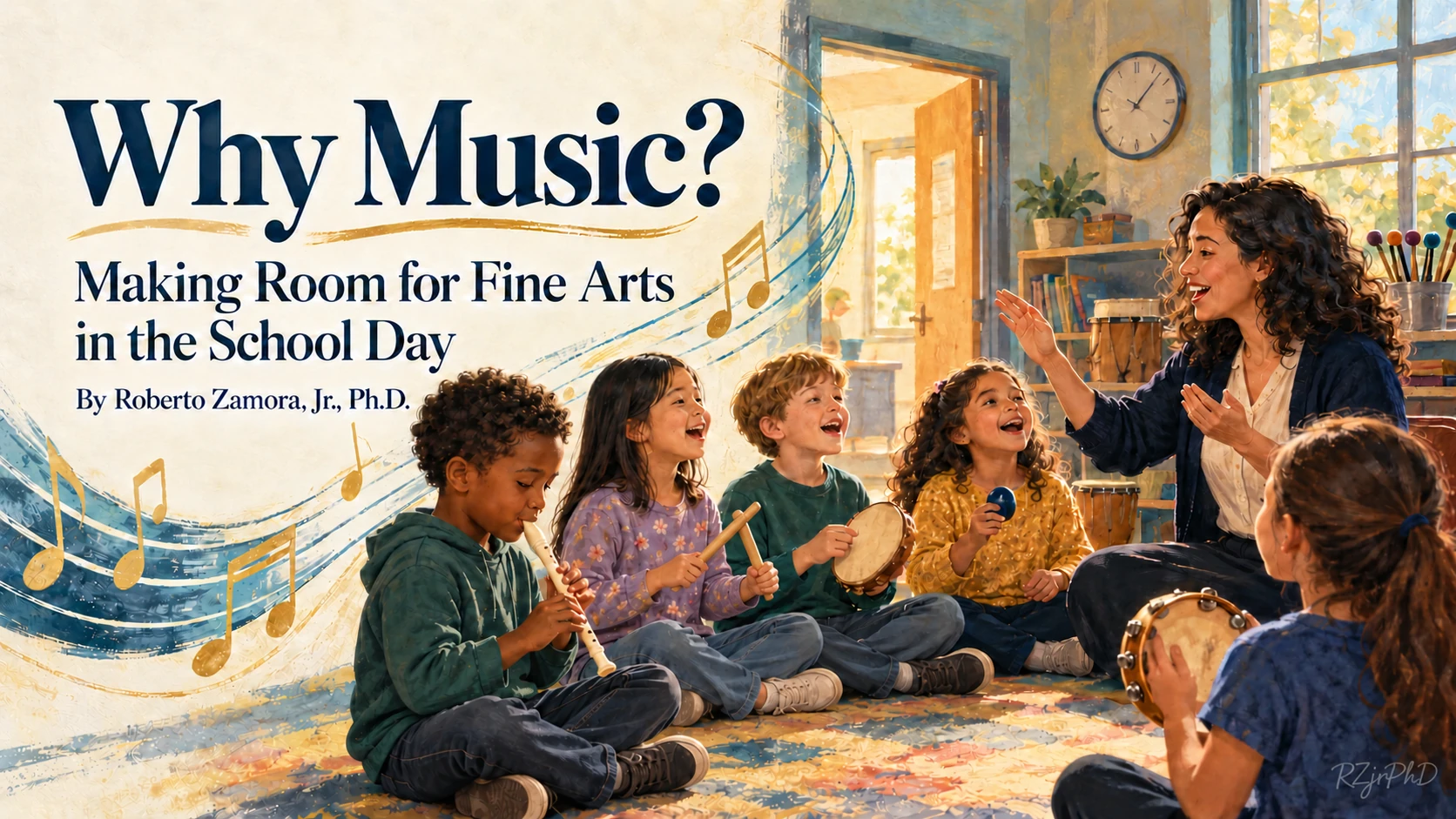
Why Music?
From 2022 to 2024, I used a small section of our Elementary Education Department’s weekly announcements to keep music and fine arts in front of campus leaders.
Sometimes the section carried an announcement or celebrated a campus performance. Sometimes it reminded principals to protect music instruction. During the 2023–2024 school year, a recurring heading asked a straightforward question: Why Music?
Those messages were part of work that had been evolving for years. As Assistant Director for Fine Arts at La Joya ISD, I was helping campus leaders understand what elementary music teachers taught, what students gained from that instruction, and what support made it possible.
Elementary music was not a state-tested subject. It did not receive the attention that came with state testing. Holding its place in the school day required deliberate effort.
The weekly announcements gave me a place to make that effort consistently, within a communication principals were already receiving.
In the January 23–27, 2023 issue, for example, I congratulated Escandon Elementary on its production of My Big Balloon. The campus music teacher had brought the work to students at the suggestion of his former college professor, who had written it. Recognition belonged in that space. Teachers and students were doing work that deserved attention beyond their own campus.
In the same section, I reminded principals that elementary students attended music for 45 minutes once a week.
Across a 180-day school year, that meant only 36 classes. Music met on just 20 percent of the school days, adding up to 27 hours of instruction for the entire year.
And that was the best-case scenario.
It assumed no student absences, no pullouts, and no classes canceled because of testing or other campus activities. A student who missed music on Tuesday might wait until the following Tuesday for another opportunity. Missing one class meant losing an entire week’s music instruction.
Even four missed classes reduced those 27 hours to 24, a loss of more than 11 percent of the year’s scheduled music instruction.
That was why I returned to instructional time so often. Music already had a limited place in the school week. Every cancellation or interruption made that opportunity smaller.
I asked campuses to make up canceled classes and offered possible scheduling approaches for doing so. Where schedules allowed, open days could accommodate missed classes. Where they did not, I encouraged campuses to consider other arrangements so students could still receive that week’s instruction.
The messages also addressed how campuses used the music room. When dances, Good Life celebrations, or other reward events took place, students who were not eligible to participate needed somewhere to go. On some campuses, that place was the music room. One reminder put it plainly:
“DO NOT USE THE MUSIC ROOM AS A PUNISHMENT SPACE.”
If a student’s memory of the music room is being sent there while everyone else is at the dance, the room starts to carry that meaning. It becomes the place a student goes when they are in trouble. I wanted it to remain what it was meant to be: a place for learning, creativity, and participation.
In the 2023–2024 school year, the “Why Music?” heading offered another way into the conversation.
The August 21–26, 2023 message focused on teamwork and collaboration. It described how ensemble participation asks students to listen, cooperate, and coordinate their contribution with others.
That issue also included an invitation to principals. If they needed a second pair of eyes or a sounding board during music and art walkthroughs, I was available to accompany them when my schedule allowed.
Explaining the subject and helping leaders observe it were connected responsibilities. A principal did not need to be a music specialist to support music instruction, but access to someone with that background could help.
The same announcement addressed scheduling multiple prekindergarten (PK) classes in the music room at once. I asked campuses to avoid overcrowding and offered alternating-week scheduling options for campuses with larger numbers of PK classes. These were practical details, but they affected the conditions in which teachers taught and children learned.
Later installments brought other parts of the classroom into view. September’s messages addressed cultural appreciation, group singing, and instrument exploration. The cultural appreciation message appeared during the week National Hispanic Heritage Month began, offering a timely way to recognize Hispanic and Latino cultures through music while encouraging appreciation for musical traditions more broadly. October’s messages turned to music and movement, with attention to coordination, rhythm, balance, and spatial awareness, and then to creative composition, with children experimenting with sounds, melodies, and harmonies. In January 2024, the topic was resilience: the challenges and perseverance involved in learning music.
These were brief messages for busy school leaders. Their purpose was to direct attention to the learning behind the performances.
While the newsletters spoke to principals, separate work was opening a channel to teachers. Getting 23 elementary campuses onto a common conference period made it possible for me to meet virtually with our music teachers as a team. Teachers on different campuses could come together during shared time to discuss instruction, exchange ideas, and address concerns.
By August 2023, the weekly announcements listed the music and art teacher conference period at 10:35 a.m. A short line in a newsletter could make that arrangement look simple. Behind it was a much longer process of working toward time when teachers could connect.
The advocacy also extended to teachers’ professional contributions. In the April 8–12, 2024 issue, I encouraged principals to support music teachers in submitting presentation proposals for the 2025 TMEA convention. Their expertise deserved an audience. Supporting the arts included recognizing teachers as professionals with something valuable to share.
Looking back through these announcements, I see the different responsibilities sitting beside one another: celebrating students, explaining instruction, protecting class time, supporting teachers, and asking principals to participate.
Some messages changed from week to week. Others returned because the underlying need remained.
That reflects my experience of fine arts advocacy. It develops through repeated conversations and practical decisions. It requires attention to what students experience and to the conditions under which teachers work. I have found that subjects outside the tested core need that kind of steady, practical attention.
From 2022 to 2024, the weekly announcements gave me one regular place to carry that conversation forward.
“Why Music?” was the question on the page. The ongoing work was making room for music in students’ schedules, in principals’ attention, and in the district’s instructional conversations.