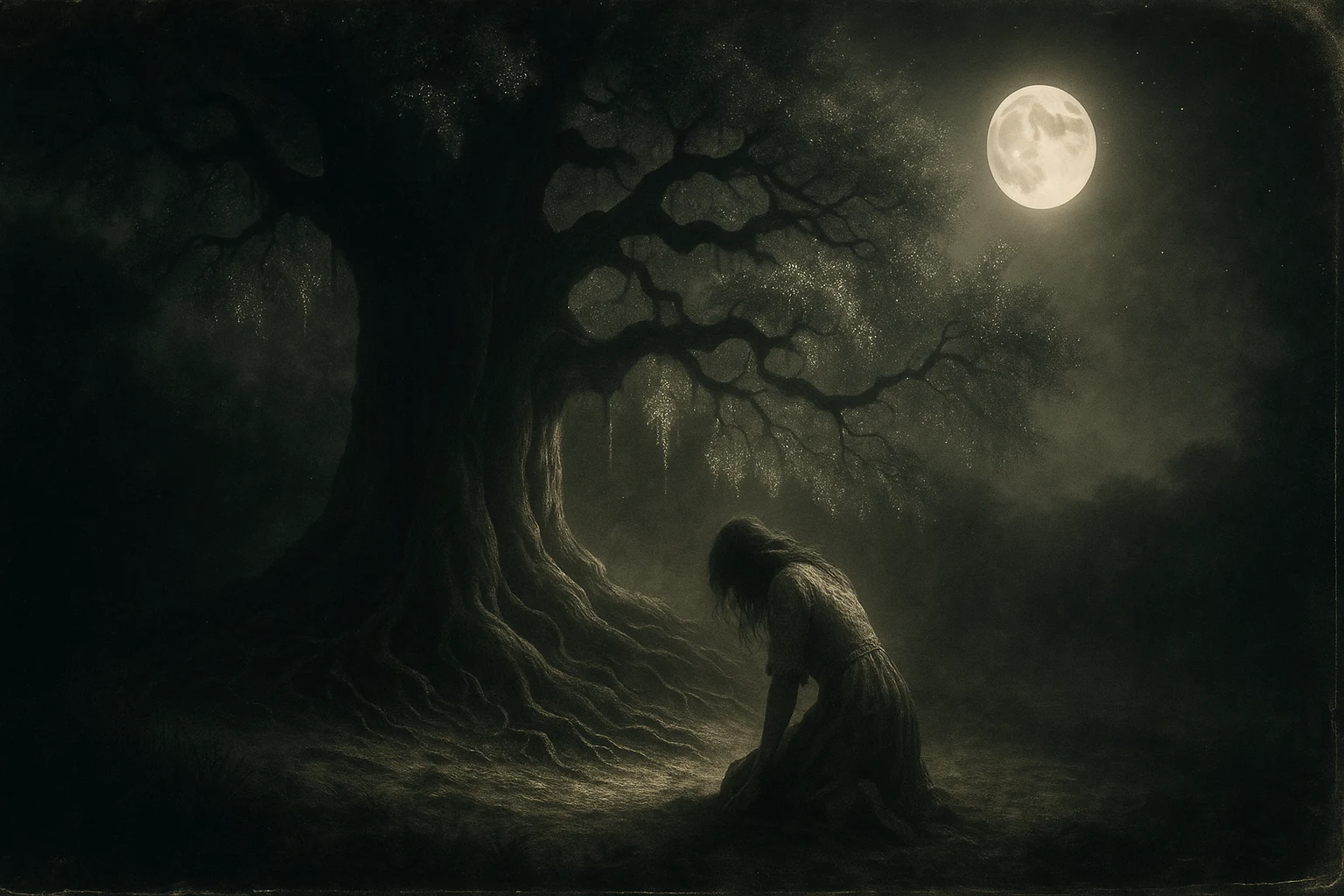
The Rio Grande Valley, 1944

The Thorns

She ran until her lungs burned.
The mesquite closed in around her. Branches she’d walked past a hundred times by daylight leaned into the path now, and every one of them seemed to reach for her. Thorns snagged her sleeve and held on. They caught in her hair and pulled her head back. They found the hem of her dress and dragged at it, as if they wanted her to stay.
She tore free, and the brush tore back.
The night smelled of smoke and kerosene and river water. Behind her, past the brush, the sky had begun to glow, and something was shouting. Maybe a man. Maybe only her own pulse pounding in her ears.
Her cheek throbbed where his ring had caught it. She could taste blood. She kept running.
She had thought she could outrun all of it: the voice, the house, the war that had taken every other man in town and left her this one. But out here, under the same moon that watched the dying men across the ocean, the land was too quiet to lie to her.
Maybe it was only the wind that moved the branches.
There was no wind.
Then one of them found the chain.
It didn’t tear her dress. It didn’t scratch her skin. It hooked the thin gold chain at her throat, the one with her mother’s medal of the Virgin, and pulled, gently, almost patiently, until it gave.
She didn’t feel it go.
She’d been praying without knowing it, the words her mother had drilled into her coming out between breaths. Acordaos, oh piadosísima Virgen María, que jamás se ha oído decir que ninguno de los que han acudido a vuestra protección, implorando vuestra asistencia y reclamando vuestro…
The prayer broke off there. For the life of her, she couldn’t remember the next word.
Ahead of her, at the edge of a clearing, something black began to breathe.
The House
Fito hadn’t always been like this.
When she married him, the spring she turned nineteen, Rodolfo could make a whole dance hall laugh. That first year he danced her around the kitchen to the radio, flour on both their hands, until the beans burned and neither of them cared. The winter Nico turned three, Fito carved him a little wooden horse with his pocketknife and sat up past midnight sanding it smooth, so it wouldn’t give the boy splinters.
Then the Army sent him home. A bad ear, the doctor said, one he’d had since he was a boy and never noticed. Every other man in town went across the ocean. Fito went back to the feed store. Every Sunday the priest read the new names from the casualty lists, and every Sunday somebody looked at Fito a little too long.
The drinking started after that. Then the women. A widow across the tracks. A girl from a dance hall in Rio Grande City. People whispered, and Socorro pretended not to hear. All she’d ever wanted was a quiet house, a steady man, and a child who slept safe. So she kept the floors swept and the beans on the stove and her mouth shut, as if she could keep the house steady all by herself.
When he beat her, it was usually late, and he was usually drunk.
Nico’s room was at the end of the hall, hardly bigger than a closet. Above his bed hung a picture of Nuestra Señora del Perpetuo Socorro, the Virgin she’d been named for. Her mother had given it to them the day Nico was baptized. In the picture the Christ child clung to his mother’s hand, frightened, one little sandal slipping off his foot, as if he’d run to her as fast as he could.
Every time, after, Socorro went to him. Her lip split, her ribs aching, she’d ease onto the edge of his bed, pull him into her lap, and rock him.
First the prayer, the way her own mother had taught her:
Ángel de mi guarda, dulce compañía,
no me desampares ni de noche ni de día.
No me dejes solo, que me perdería.
Then the song.
Naranja dulce, limón partido,
dame un abrazo que yo te pido.
Sweet orange, sliced lemon, give me a hug, I’m asking you.
He’d hold her medal in his fist while she sang, the little Virgin warm from his hand. He never once asked about the bruises. He only ever asked her to sing it again. And he always fell asleep before adiós, so she’d have to unfold his fingers one by one to get free.
The Fight
That night he came home after ten, smelling of mezcal and someone else’s perfume.
She didn’t say anything. That was the mistake. He wanted her to say something.
Supper had gone cold on the stove, so he swept the plate off the table with his arm. Then he wanted to know where she’d been all day, and who she’d talked to at the market, and why Chuy Saldaña had tipped his hat to her outside church.
“I don’t know,” she said. “¿Por qué no le preguntas?”
From the end of the hall came a small sound. Humming.
Nico was awake. Of course he was. She could hear him through the thin wall, humming her song softly to himself, the way he did whenever the shouting started. Not to drown it out. To hold on until she came.
Then his door creaked open, and a small voice came down the dark hall. “Amá? Apá? Me voy a portar bien. Me voy a portar bien.”
“¡Métete a la cama!” Fito roared, and the door shut again.
The first blow knocked her into the table. The kerosene lamp rocked, tipped, and rolled off the edge. It landed behind the stove and didn’t break, not right away. The wick lay in a spreading pool of kerosene, still burning, small and blue.
Neither of them saw it, because by then he had her by the hair, swinging her around like a rag doll.
The Door
She got loose. She never knew how. She was out the back door with a fistful of her own hair still in his hand, and he was coming after her, roaring her name, stumbling into the doorframe.
“¡Socorro!”
The back door had an iron hook on the outside. Fito had put it there himself, years ago, to keep the screen from banging in the wind. Socorro pulled the door shut behind her and dropped the hook into the eye.
It would only slow him down and fuel the rage that was building inside him. Still, that would be long enough for her to get away.
He hit the door with his fist once from the inside, so hard it rattled the hinges. Then the smell reached her, and it terrified her.
Kerosene. Burning.
Through the kitchen window the light was different. Orange, and climbing the curtains. Little demons, devouring everything they touched. The front door was on the far side of the kitchen, where the fire was.
“¡Socorro!” Fito was pounding on the door now with both fists. “¡Socorro!”
Her name was the word for help. Was he calling for her? Was he calling for help? Did it matter?
And under it, from the end of the hall, a smaller voice.
“¡Amá!”
Not help me. He’d never asked her to help him. He was calling her the way he did every night, after. This is the part where you come.
Then, fainter, through the wall, the words she’d taught him to say when he was scared and she wasn’t there yet. No me dejes solo, que me perdería. Don’t leave me alone, or I’ll be lost.
She stood in the yard with the demons in the window. Three steps to the door. She could lift the hook. She could lift it, and Fito would come through that door. She could lift it, and Nico would come through that door. She could lift it, and all the rage would come through that door.
Fito will get him, she told herself. Fito will break the window. Fito will carry him out.
She took a step back.
Then another.
Then she turned, and started walking away. Slowly at first, then faster, then running, and then… it was all a blur.
The Tree
It was a tree unlike the others. Its bark shimmered as though wet, black against the pale wash of moonlight. It seemed to breathe, swelling and settling with a rhythm that had nothing to do with the wind. The branches twisted toward the sky like reaching arms, their silver leaves trembling in a language her body almost understood. The air above it rippled the way heat does off a caliche road at noon in August, but the night was cold.
She took a step closer. The scent of iron filled her lungs. Fear turned inside her chest, softening into something more dangerous.
Recognition.
“Please…” She stumbled to her knees. “I didn’t mean…”
The tree answered her in a thousand voices. All speaking at once. All saying something different. All saying the same thing. All her voice. All strangers’ voices.
They rose from the roots… the dark… disembodied… and all achingly familiar.
You locked the door, one voice moaned, soft and wet with tears. Or was it many?
He called your name, others hissed, sharp as splintered glass. Or was it only one?
And you walked away, it murmured, they murmured, fading into the sound of the river.
She couldn’t tell anymore where one voice ended and the next began. Every one of them was hers, his, theirs.
The leaves caught the moonlight, glittering and shivering in tandem with the voices in the air. The voices piled over one another until they became a swirling storm of grief and accusations. She pressed her palms into the soil as if she could hold the ground still, almost as if taking root like the tree itself.
“I didn’t mean for him to die,” she cried. She couldn’t have said which of them she meant.
Then, beneath the storm, a voice that didn’t accuse her at all. Small. Patient. Humming.
Amá, ¿ya vienes?
Amá, are you coming?
His voice slipped from the question into the prayer and into the song, as if they were all the same thing. To him they always had been. Ángel de mi guarda… naranja dulce… no me dejes solo… limón partido… dame un… a… bra…
Then the tree took their prayers and gave them back in the old tongue of the Mass, the priest’s language, the one she’d knelt through every Sunday of her life and never understood.
Angele Dei, qui custos es mei…
Memorare, O piissima Virgo Maria, non esse auditum a saeculo, quemquam ad tua currentem praesidia… esse derelictum.
She didn’t know the words, but she knew what they meant.
Her hand flew to her throat, to the medal, the way it always did when she was afraid.
There was nothing there. She panicked. It was as if she were strangling herself, searching for the medal.
The tree exhaled, and its breath carried the scent of rain and smoke and kerosene.
Every sorrow finds its soil. Every sin finds its home.
“Ya quiero que se acabe,” Socorro whispered. “Quiero silencio. Nomás los quiero de vuelta. Por favor. Quiero volver a casa.”
I want it to be over. I want quiet. I just want them back. Please. I want to go home.
The ground pulsed beneath her palms, as if the earth itself remembered every promise ever whispered there. Every secret bargain. Every plea that had gone unanswered. The roots shifted like veins under the soil.
She tried to pull back, but her hands were already slick with sap. Dark as blood, warm as breath. The more she struggled, the more it clung to her skin, winding up her wrists like crimson thread.
The branches shuddered and scattered silver leaves that caught the moonlight like shards of glass. One fell across her face.
For a moment, the world went dark. For a moment, the world went silent. For a moment, everything stopped.
Then the whisper changed. It wasn’t angry now. It was resolved.
All debts return to their roots. And every sin seeks soil.
And beneath it, over and over, like a clock whose hands never move:
Nunc et in hora. Nunc et in hora.
The sap burned hotter, seeping into her veins, flooding her heart until her pulse matched the rhythm of the earth. This was not punishment. It was reclamation. She didn’t hate it. She almost loved it. She mostly feared it.
Her mother had named her for the Virgin. Perpetuo Socorro. Help without end.
Now she understood the word that came before her name.
The Night Without End
The lamp was lit on the kitchen table.
Supper had gone cold on the stove. The floor was swept. Somewhere down the road a truck door slammed, and boots came up the porch steps after ten, and the smell of mezcal and someone else’s perfume came in ahead of him.
At the end of the hall, a small voice was humming.
She was home. They were all home. The tree had given her exactly what she asked for.
She knew what came next. She knew all of it. She tried to say something different this time, to stand somewhere else, to walk down the hall to his room before the first blow ever came. Her feet carried her to the table anyway, the way they had the first time.
The lamp tipped. The hook dropped into the eye.
¡Socorro!
¡Amá!
And every time the night ended, it began again. Every time, one more voice joined the chorus inside the tree: another Socorro, standing in the yard with the fire in the window, taking a step back.
In the little room at the end of the hall, Nico waits for her to come and sing. He never grows older. He never learns why. He hums the song she taught him, and he waits.
She never comes.
She never comes.
She never comes.
…nunc et in hora mortis nostrae. Amen.
She ran until her lungs burned.
The Legend
They say it happened during the war years, out past the old road, where the mesquite grows too close to breathe.
By morning the house was nothing but a black chimney and a smell that hung over the brush for weeks. They found two bodies inside: a man in the kitchen, a few feet from the back door, and a little boy in the room at the end of the hall. He was curled on his bed, facing the door, as if he’d been waiting for someone.
The back door was still hooked shut from the outside. They never found her.
The town never agreed on what happened. Some said Socorro had been running around too, and Fito only found out that night. Some said Fito had it coming and God forgive them for saying so. Some said she set the fire herself. No one ever proved a thing. But guilt has a scent, and the land remembers.
The men who searched the brush found her footprints running toward the river. And hanging from a mesquite thorn, they found a thin gold chain with a medal of the Virgin, turning slowly in the breeze. Her mother knew it the moment she saw it. She’d given it to Socorro on her First Communion.
The footprints ended at the edge of a clearing, beside an old black tree that no dog would go near. Folks said its leaves shone brighter that year than anyone could remember.
Nobody ever rebuilt on that lot.
They say if you’re down by the river after dark and you hear a man shouting ¡Socorro!, don’t go looking. Nobody out there is asking for help. He’s still calling for her.
The old women of the ranchos stopped singing Naranja dulce near the river. Nobody remembers deciding it. You just didn’t. Their granddaughters learned it at school anyway, and every so often, one of them would hum it walking home along the riverbank and hear it answered from the brush. A small voice, a few notes behind, trying to keep up.
It never gets as far as adiós.
Some nights, they say, the humming is the only sound the tree makes. As if the old thing were listening to it.
So if you ever wander near the river after dark and the air feels heavy, don’t whisper your secrets to the wind.
The tree is listening. It always is.