
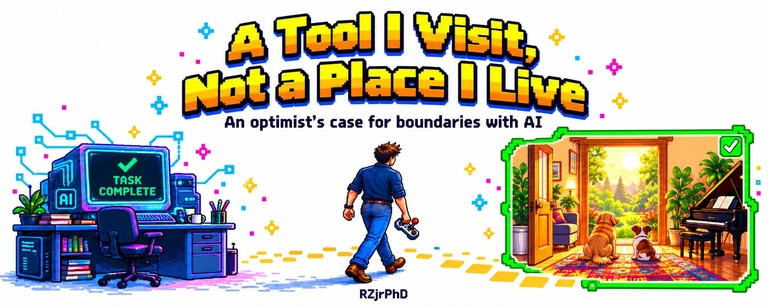
A Tool I Visit, Not a Place I Live
I was born in 1969. I grew up in a world without the internet, without a computer in every house, and without a smartphone in everyone's pocket. Today, I have a hard time imagining my life without them.
I remember that world. I'm a Gen Xer who came of age in the '80s, which means I got to watch the future arrive one gadget at a time. For me, it started with an Atari hooked up to the family TV. The graphics were blocky and the sound was mostly beeps, but I thought it was totally awesome. Who knew that one day I'd be carrying a device in my pocket with more computing power than NASA used to get astronauts to the moon in July 1969, just a few months before I was born. And not just the computer on board, but the room-sized mainframes back here on Earth.
Gen Xers have a foot in both worlds. We remember the before, and we live in the after. There will always be some nostalgia for simpler times and analog things, but knowing what I know now, I don't think I'd want to go back. Some things really are better here.
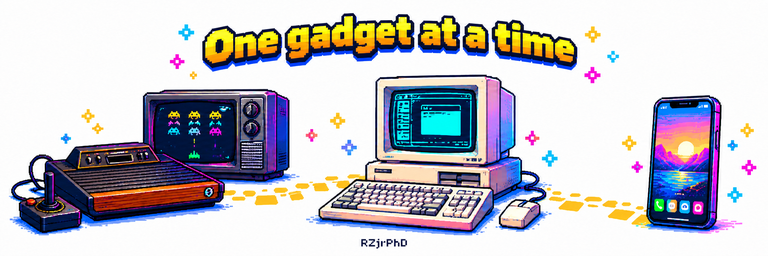
I enjoy technology. I'm curious about what it makes possible, and I've generally been eager to explore it. I grew up loving science fiction, and some of what I watched as a kid is now sitting on my desk. Artificial intelligence is part of that curiosity. It helps me work through ideas, process my thoughts, and move forward on tasks I've been putting off or struggling to finish.
So when conversations about AI almost immediately turn toward catastrophe, I find myself wanting more room for possibility. I'm a Star Trek fan. I've always loved its promise to boldly go where no man has gone before, and part of what draws me to that world is the belief that technology can help us learn, explore, and build a better future. I believe we can get there. The story doesn't have to end in Skynet.
People are often uncomfortable with change, and fear of the unknown makes it worse. But AI isn't going away. The invitation is to get curious, understand its possibilities and limitations, and decide where it belongs in our lives. That doesn't mean ignoring what could go wrong. It means giving the same serious attention to what could go right, and to what we can do to help it go right.
I suppose I'm more optimistic than I give myself credit for.
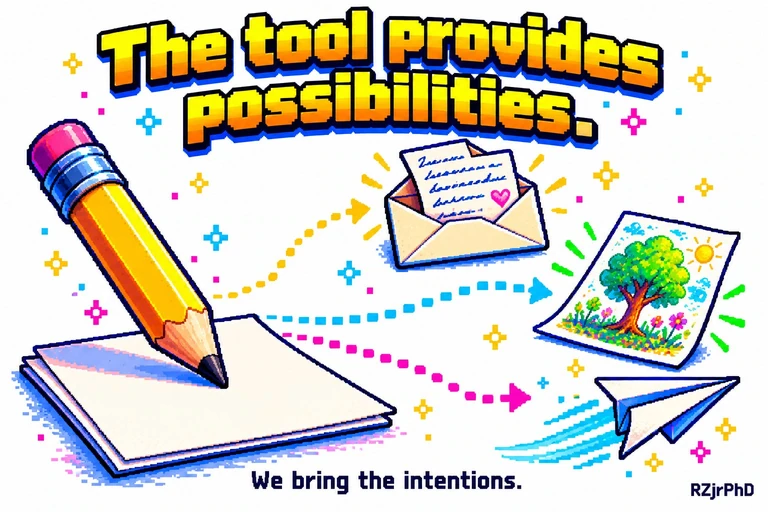
These thoughts had already been taking shape over a few weeks of texting with two friends, from mid-September to mid-October. We were discussing AI, its possibilities, and the responsibility that comes with using it. In one exchange, I offered an example: give a group of people a pencil, paper, and ten minutes to do whatever they want. Someone might write a letter. Someone might draw. Someone might make a paper airplane. Someone might do nothing at all. Even the letters could be an encouragement, an apology, or a straight-up lie.
"The tool provides possibilities. We bring the intentions," I wrote.
Later, while watching Dr. Fei-Fei Li's MasterClass, AI's Future—and Yours, I was struck by her statement:
"How we allow ourselves to be empowered and augmented by AI should be up to us, and that's the human agency we need to preserve on the use of this technology."
What stayed with me was "should be up to us."
That phrase got me thinking about something beyond artificial intelligence: the relationships we develop with the things that occupy our lives.
We have relationships with our work, with money, with technology, and with the habits we turn to for comfort or stimulation. Smartphones are a familiar example. We can become so absorbed in the screen that we give more attention to the phone than to the person sitting beside us.
Those relationships take up time and attention. They can support what matters to us. They can also grow larger than we intended. So the real question is what relationship I'm choosing to have with each of them, and whether it reflects what I value.
A conversation with someone I trust gave me a useful way to picture that.
Imagine a pie chart of your life. Divide it according to what you believe deserves your time and attention. For me, the largest share should belong to my family, my friends, my pets, and the life I share with them. Work has a place. So do my interests and creative pursuits.
Then draw another chart showing where your time and attention actually go.
Does the pie chart of my actual life match the ideal I've set as my goal?
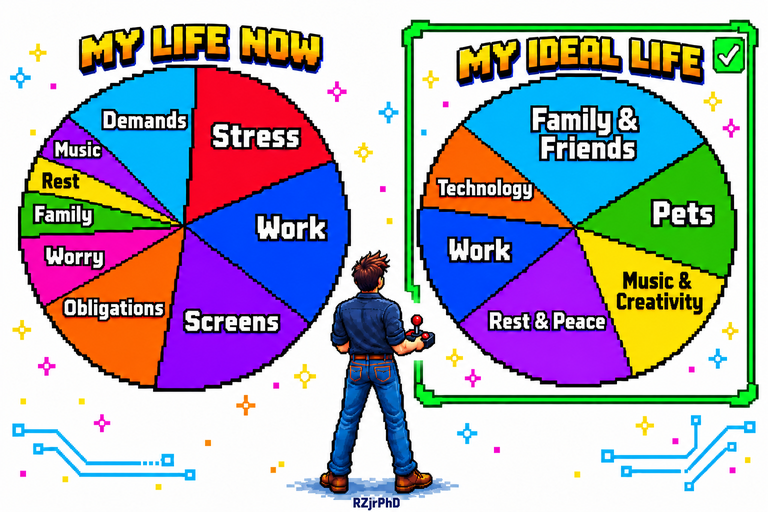
The difference between those two pie charts can tell me something. What I say matters most should be recognizable in how I spend my days. An hour spent is an hour of my life, whether I spent it deliberately or barely noticed where it went.
That conversation began with the stressors and competing demands taking up more space in my life than I wanted to give them. But the same exercise applies to AI, smartphones, time at the gym, or anything else that occupies a meaningful part of our lives. Even something beneficial deserves a closer look when it starts crowding out other things we value.
I've experienced how much time AI can save. Recently, I told my friends that work on my website that had taken weeks the year before had taken just a few hours this time. Both efforts involved AI. As someone who doesn't code, I found that amazing!
In that same conversation, I also joked about getting pulled down an AI rabbit hole. It wasn't entirely a joke. One evening I sat down with a single question, and by 11:15 that night I'd used up every credit on my Pro account. My curiosity can keep me there long after the original task is finished.
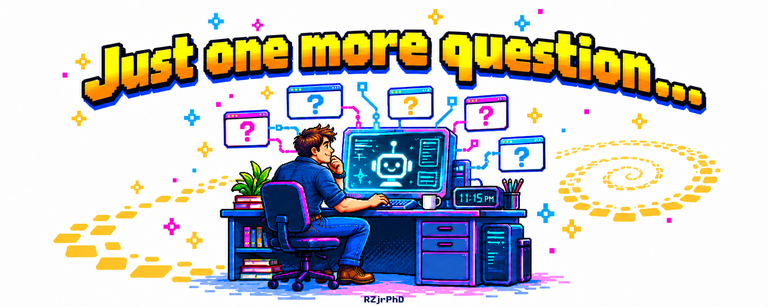
So what happens to the time I save? Am I spending it with the people and on the things in my ideal pie chart, making room to rest, play music, or follow through on something I care about? Or am I filling it with another round of tasks and questions and... rabbit holes?
I can appreciate how useful AI is and still ask whether the space it occupies is the space I want to give it.
In that earlier conversation with my friends, I wrote that receiving assistance isn't the same as surrendering responsibility. I still want to exercise my own mind: to question an answer, work through an idea, imagine alternatives, and decide what I think. Capability and judgment aren't the same thing. Not everybody with a driver's license should be driving, and sometimes wisdom is knowing not to go to H-E-B at peak times. If anything, a more capable tool gives me more reason to keep developing mine.
That brought me to a sentence I want to remember:
AI should be a tool I visit, not a place I live.
Perhaps people will someday spend much more of their lives in environments shaped by AI. I don't know what that future will look like. For now, this is the relationship I want to have with it.
The value of the visit matters. Did it help me finish something, understand something, or create something I care about? Did the time I spent there return something useful to the rest of my life?
And am I returning to that life?
This is where boundaries matter. They help me protect my peace and make room for the people and experiences I want at the center of my life. A tool can be useful without having unlimited access to my attention. As a friend put it, it's all about what we give it permission to do.
We make decisions about access in our personal relationships, too. How available we are to someone can depend on the quality of that relationship and its effect on our lives. We can care about someone and still need boundaries. I can bring that same awareness to the place technology occupies in my day.
A boundary might mean putting the phone away when I'm with my family or friends, deciding when the workday is finished, or ending an AI conversation once it's helped me do what I came to do. There will always be another question to ask or another possibility to explore. I can leave some of them for tomorrow.
It's easy to say we get to choose. Living that choice is harder. Phones are designed to light up and pull us back. Algorithms learn what keeps us watching and queue up the next video before the last one ends. Habits and obligations narrow our options in ways we don't always notice. We hand it over, as that same friend said, one shortcut at a time. Sometimes keeping a boundary takes support. Sometimes it means changing the conditions around us. And sometimes it begins with simply noticing that the relationship has changed.
That's also why the responsibility can't rest entirely with the person holding the tool. Spider-Man fans know the line: with great power comes great responsibility. And a lot of AI's power sits with the people building it. My pencil-and-paper example was about the intentions we bring. With AI, other people's intentions are already in the room. People decide what these systems learn from, what they're encouraged to do, where their limits are, and what they're used for. As a creative person, I know that what we make carries something of us: our priorities, our assumptions, our hopes, and our blind spots. The people building these systems have a responsibility to preserve meaningful choice for the rest of us, and we have every right to ask whose interests their choices serve.

I'm still optimistic. That optimism has room for scrutiny, and room to decide that something useful has started taking up too much space. A smarter tool doesn't automatically make us wiser or kinder. That part is still on us. Dr. Li said that how we're empowered by AI should be up to us. For me, that means having a real say in where it fits in my life, and the freedom to change my mind.
When the task is done, I want to close the laptop and go back to the people, the pets, and the music that belong at the center of that pie chart. A good visit should leave me more ready to go home.
Thanks to my friends for a great conversation that got me thinking.